
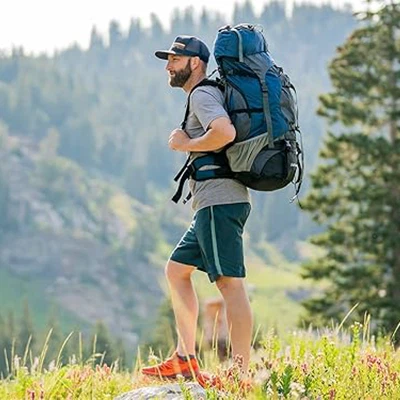
Whether camping, rock climbing, hiking, or traveling, we all need a backpack that’s spacious yet lightweight. It can significantly enhance the quality and comfort of our outdoor activities. However, with so many different backpack styles available, choosing one can be overwhelming. How can you choose the right one for you? Don’t worry, USL will explain how in this guide.
1. Height
Imagine a smaller person carrying a large 50L outdoor sport backpack. Wouldn’t it look strange? Of course. Besides looking odd, an oversized, ill-suited backpack can also put pressure and strain on the wearer, potentially impacting their back and waist. Therefore, users of different heights should consider different sizes of backpacks.
Measuring Back Length
It’s important to note that choosing a outdoor sports backpack based on height isn’t about overall height, but rather back length, which is the vertical distance from the seventh cervical vertebra to the upper edge of the pelvis at the waist. Different back lengths will result in different sizes of suitable outdoor sports backpacks. Before we get into the details, let’s take a look at how to measure back length.
When measuring, we first need to locate two points: your C7 vertebra and your iliac crest. To find your C7 vertebra, simply lower your head. The protruding bone in your neck is your C7 vertebra. As for the iliac crest, you can place your hands on your hips and extend your thumbs back. The top of your hip bones is the iliac crest.
Once you’ve located the two corresponding points, have another person help you. Place one end of a tape measure on your C7 vertebra and stretch the tape measure down your spine until it reaches the iliac crest. This measurement is your back length.

Backpack Sizes for Different Back Lengths
If your back length is less than 40cm, you’re probably suitable for XS/S; 40-45cm for S/M; 45-50cm for M/L; and over 50cm for L/XL. You can usually find the outdoor sports backpack’s corresponding back length and size on the tag. If it’s not specified, ask the seller to avoid buying an inappropriate outdoor sports backpack.
2. Trip Duration
It’s important to understand that a single outdoor sports backpack won’t meet all your needs. Therefore, before deciding on a outdoor sports backpack, consider the length of your trip or travel. This will help you choose the right capacity.
For a one-day trip, you’ll only need a few basic items, such as a power bank, 1-2L of water, a spare set of clothes, a bottle of outdoor sunscreen, and your ID card. Therefore, a outdoor sports backpack with a capacity of 25-35L will meet your needs.
If your trip is two to three days, choose a outdoor sports backpack with a capacity of 35-50L. This allows you to pack more items, such as a toiletry bag, two or three changes of clothes, some food, and a lightweight sleeping bag.
For trips longer than three days, choose a outdoor sports backpack with a capacity of 50L or more, especially for camping trips, as you may also need to bring a tent, thermal pad, and sleeping bag in addition to clothing and food.
3. Backpack Material
Most outdoor sports backpacks are made of waterproof fabrics such as nylon or polyester, often with a DW coating, which significantly enhances the outdoor sports backpack’s water resistance. Some backpacks also include a rain cover in the bottom pocket for use in heavy rain. If your outdoor sports backpack doesn’t have a built-in rain cover, USLiNT recommends purchasing one separately and placing it inside your outdoor sports backpack.
In addition to waterproofing, we also need to consider the fabric’s abrasion resistance. Outdoors, it’s easy to encounter scrapes from branches and rocky slopes. If the material isn’t abrasion-resistant, it can easily break, causing stored items to spill out, which can be extremely troublesome. To understand the abrasion resistance of a backpack’s material, we can look at the material’s value. Generally, a higher value indicates greater abrasion resistance. For example, 600D polyester is more abrasion-resistant than 300D polyester.
4. Backpack Structure
Outdoor sports backpacks vary in structure, which can have varying impacts on the carrying experience and comfort.
Frameless or Not
Some outdoor backpacks are designed with an internal frame, which evenly distributes weight across your hips and shoulders, reducing the burden on your back and waist, thus improving the backpack’s overall stability.
Framed backpacks are suitable for longer trips. For shorter trips, a frameless backpack is more lightweight and reduces the weight burden.
Are the shoulder straps/load adjuster/sternum buckle/hip belt adjustable?
Adjustable designs allow the outdoor sports backpack to better fit your body. By adjusting the shoulder straps, you can create a more comfortable fit around your shoulders and prevent them from flapping.
The load adjuster adjusts the angle between the top of the backpack and your shoulders, shifting some weight to the hip belt, reducing the pressure on your shoulders and back.
Adjusting the height and tightness of the sternum buckle stabilizes the shoulder straps, preventing them from slipping during hikes and other activities, and maintaining a balanced weight distribution.
In addition to providing stability, the hip belt also effectively distributes weight, placing more weight on the hips than the waist, protecting the lower back.
In short, an adjustable design can adapt to different body shapes, ensuring that the outdoor sports backpack meets different needs.
Back Ventilation
Back ventilation on an outdoor sports backpack is crucial, especially in hot summer weather. It effectively reduces sweating and stuffiness, improving comfort during extended wear.
Most outdoor sports backpacks have this feature. Some use curved supports to create an air channel between the backpack and the back, enhancing back ventilation. Others use a “sandwich” design on the back panel, creating an air channel between the backpack and the back, while also absorbing sweat and allowing for breathability.

Number of Compartments
Outdoor sports backpacks generally have a large number of compartments, allowing for better organization and storage. Therefore, consider the number of compartments you need when choosing.
Modular Design
Outdoor sports backpacks often feature removable components, such as a removable top pocket, external modules for water bottles, sleeping pads, tool bags, and removable mesh pockets. This modular design greatly enhances the backpack’s flexibility, allowing you to customize it to your needs.
5. Backpack Weight
Besides the weight of your luggage, you also need to consider the backpack’s weight when traveling outdoors. While maintaining sufficient support, a lighter backpack reduces weight, which is crucial for long walks.
6. Price
When choosing an outdoor sports backpack, don’t overly focus on price. Instead, consider whether the backpack meets your specific needs. Choosing a suitable and cost-effective product within an acceptable price range is a wise and sensible choice.
Choosing the right outdoor sports backpack can significantly enhance your outdoor travel experience. Comparing the six factors mentioned above can significantly increase your chances of finding the perfect backpack. As an experienced outdoor sports backpack manufacturer, USL can provide ODM/OEM services. You can send us your requirements and we can provide you with cost-effective outdoor sports backpack solutions based on your needs.