
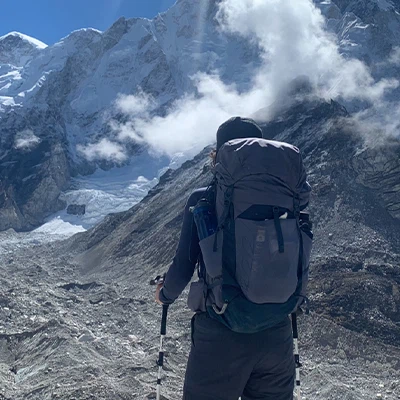
Mountaineering backpacks have more complex and extensive structures than everyday backpacks. This is because they must ensure both ample capacity and carrying comfort. Comfort requires the simultaneous functioning of these structural components. USLINT specializes in providing high-performance, high-quality mountaineering backpacks and possesses expert knowledge of mountaineering backpack construction. Today, USLINT will share with you what constitutes a mountaineering backpack’s structure.
Frame
With technological advancements, most modern mountaineering backpacks utilize an aluminum alloy internal frame design. This not only provides support but, combined with nylon shoulder and hip straps, allows the packed backpack to rest snugly on the user’s back, improving carrying stability. Another advantage of internal frame mountaineering backpacks is even weight distribution, reducing the burden on the back. However, it’s important to note that internal frame mountaineering backpacks are less breathable than external frame mountaineering backpacks.
Pockets
A mountaineering backpack’s pockets are more diverse and complex than those found on regular backpacks. They typically include top pockets, main compartments, side straps, front pockets, hydration straps, hip belt pockets, hidden pockets, and rain cover pockets. These pocket types greatly meet the need for compartmentalized storage and effectively keep items safe and dry, protecting them from external contamination.
Zipper
Zippers affect the efficiency and security of a mountaineering backpack’s opening and closing. Many mountaineering backpacks use waterproof zippers to prevent moisture from seeping into the bag and contaminating items. High-quality mountaineering backpacks use YKK zippers for increased reliability and smooth operation.
Backpanel
A backpanel is a crucial component of a mountaineering backpack. A good mountaineering backpack’s backpanel should be soft, comfortable, breathable, and supportive. Therefore, most mountaineering backpacks use a highly padded and mesh design to maximize air circulation.
Shoulder Straps
Shoulder straps primarily secure the mountaineering backpack to the back while also supporting weight. They are often inward-curved and filled with materials such as foam or sponge. Most mountaineering backpack shoulder straps are adjustable, allowing people of all shapes and sizes to adjust to a comfortable length and reducing back and shoulder strain.
Weight Belt
To further secure a mountaineering backpack, additional weight belts are sewn onto the mountaineering backpack shoulder straps and fitted with buckles. These buckles bring the shoulder straps closer together, shifting some of the weight from the shoulders to the chest muscles, effectively reducing the feeling of the pack tilting backward.
Waist Belt
Waist belts generally consist of internal padding, inner and outer waistband straps, buckles, waistband stabilizers, and a load-bearing structure. There are continuous and stitched constructions, with continuous constructions offering greater stability.
Waist belts transfer most of the mountaineering backpack’s weight to the hips, reducing the weight on the back and making them a key component in reducing fatigue while climbing. Generally, larger backpacks require greater weight and therefore have wider waist belts. For enhanced comfort, waist belts are often lined with a mesh and soft, thick foam to conform to the hips.
The inner and outer straps refer to the area covering the seat cushion and the exposed layer of the hipbelt, often made of abrasion-resistant fabrics such as nylon.
The hipbelt stabilizer is an auxiliary strap that helps the mountaineering backpack fit more snugly around the hips.
The load-bearing structure is designed to prevent the hipbelt from deforming under load and is often made of thermal foam that provides good support and resists deformation.
Buckles
Both shoulder straps and hipbelts require buckles for optimal performance. Common buckle types include push buckles, ladder buckles, and hook buckles, and are made of materials such as plastic and metal. They primarily provide adjustment and secure connections.
Compression Straps
A mountaineering backpack may have compression straps on the side, front, or bottom. They are primarily used to tighten the mountaineering backpack to reduce movement of internal items and can also be used to secure gear to the outside of the mountaineering backpack, further enhancing its functionality and stability.
Tool Loops/Attachment Points
Tool loops/Attachment Points are typically located on the top, sides, or bottom of a mountaineering backpack and are primarily used to attach external gear such as crampons, rock plugs, and trekking poles.
The above is a brief introduction to the structure of mountaineering backpacks. Only by fully understanding the structure of mountaineering backpacks can you quickly express your desired customization needs when customizing a mountaineering backpack, which is a key factor in accelerating your business efficiency. As an experienced provider of custom mountaineering backpacks, USLINT is happy to assist you with your custom mountaineering backpack project. Please feel free to contact us.
